Our solutions are aligned with the global Sustainable Development Goals
Learn more about how partnering with us contributes to a more sustainable world, including better health, greater gender equality, decent working conditions, and economic growth.
Do you often think about your employees’ engagement? Have you also tried to figure out how it affects your company financially? Here, we break down what it actually costs to have disengaged employees and, most importantly, how you can work to create a workplace where people thrive and feel passionate.
From a global perspective, we’ll start with some good news: employee turnover has decreased significantly in recent years. According to data from Achiever , the percentage of employees planning to look for a new job has dropped to 35 percent, down from a previous high of 74 percent. That’s a pretty dramatic change.
The key here is not to confuse apples with oranges. Just because your employees have no immediate plans to change employers doesn’t mean they’re brimming with enthusiasm. The same study found that only 21 percent of employees were highly engaged in their work, meaning that the majority would rather get off the bus but chose to stay on for various reasons. There are many reasons why people don’t get off the bus, and we could delve very deeply into this and focus solely on Sweden, but one thing we can be sure of is that when you don’t feel engaged, you won’t go the extra mile—neither for your employer nor for your own personal development.
This lack of passion in the workplace is costing you money. According to Gallup , disengaged employees have 37 percent higher absenteeism, 18 percent lower productivity, and 15 percent lower profitability. Note that this is an American study, but we can certainly draw parallels to our own, more immediate reality.
But what does a disengaged employee actually cost? Gallup has found that an actively disengaged employee costs your organization $3,400 for every $10,000 they earn, which amounts to 34 percent.
Let's play a little number game
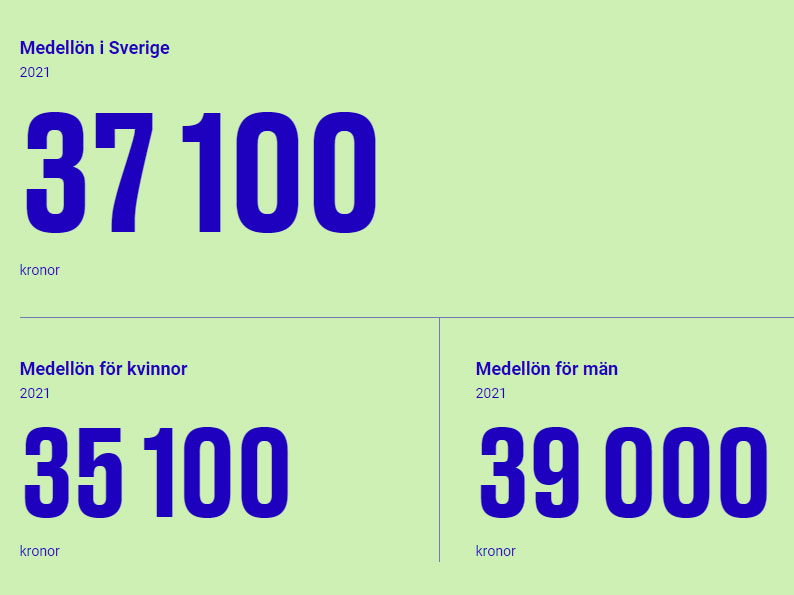
The average annual salary in Sweden is 445,200 SEK (37,100 SEK per month), according to Statistics Sweden’s data for 2021. In this discussion, we will avoid delving into the topic of varying salaries across different professions—since these naturally differ significantly—or, for that matter, the gender pay gap, and instead focus on the total figure.
34 percent of 445,200 SEK is approximately 151,000 SEK.
This means that a single employee earning the average salary will cost you and your company over 150,000 SEK per year. Increase the monthly salary to 78,000 SEK—to take a more extreme example, which is the average salary of an operations manager in construction, civil engineering, and mining—and it will cost you just over 318,000 SEK per year.
What happens if we apply this principle to the entire company? Let’s continue with some examples.
You own a company that employs 150 people.
According to a study by Achievers, which shows that only 21 percent of employees are engaged, we can assume that about 118 of these 150 employees are disengaged.
Let's say the average salary at your company is 450,000 SEK per year.
This means that this lack of engagement costs your company approximately 18 million per year.
Just a reminder that the data underlying these calculations isn’t based on Swedish studies and should therefore be taken with a big grain of salt—but doesn’t it still say a lot? Granted, the example above is exaggerated and rarely applies to a Swedish company, but wouldn’t it be enough to cut the above cost in half and still be concerned about how a lack of passion affects profitability?
What can you do?
Start by acknowledging to yourself that you likely have areas to improve when it comes to boosting engagement within your organization. This is essential if you are to take proactive steps and work toward increasing passion over the long term. This is often the biggest challenge—self-reflection, or at least a critical examination of the organization. According to the same study by Achievers, only 9 percent believe that leaders in their companies are committed to cultural initiatives, and 58 percent say that their leadership either takes no action regarding corporate culture or is merely reactive rather than proactive.
The next step is to bring the team on board. Make the process transparent and involve them in the challenge—and, above all, in the initiatives you’re working on.
“Employees want to be heard and understood, even if all it takes on the manager’s part is to say, ‘I hear you and I understand you,’” says Dr. Natalie Baumgartner, Chief Workforce Scientist at Achievers.
Part of the problem today is that many managers leave something to be desired when it comes to soliciting, listening to, and responding to employee feedback. Do you promote a listening and proactive leadership style in your organization?
To demonstrate real change, it’s crucial to take action—not just acknowledge to employees that you’ve listened to them. Let’s say you recently conducted an employee survey or a pulse survey, where employees took the time to provide feedback and share their thoughts on areas for improvement. What’s the next step? First and foremost, don’t keep the data locked away in the executive office. Share the results with everyone in the organization. Don’t hide anything. The worst thing you can do is not be transparent about the results and the initiatives you’re taking (ideally, you should decide on the latter together)—that only increases the lack of engagement.
Please follow this process:
Always be transparent about the results when conducting surveys. You may want to start by analyzing the data, involving managers, and so on, but be sure to make the results official within the organization. And resist the temptation to highlight only the positive aspects.
Involve all employees, not just managers. Use workplace meetings, employee reviews, and department meetings to discuss the results and identify 1–3 actions you want to work on together to create a more attractive workplace. When you shift ownership of these initiatives to the individual and group levels, things start to happen.
Use ongoing heart rate monitoring to track your progress, and don’t be afraid to adjust your approach based on the results.
Be sure to “close out” actions once you have completed them and achieved your goals, and then develop new actions based, of course, on the results of the surveys. This is an ongoing, never-ending workflow.
Feel free to try Hartic for free for 14 days which allows you and your organization to work according to the process described above. It’s a tool that fosters long-term engagement, and as you’ve already figured out, there’s a lot of money to be saved.
The Confederation of Swedish Enterprise, LO, and PTK have agreed to extend support for workplace safety training. The new agreement covers the period beginning September 1, 2024
In the heart of the Norrbotten coastline, far from the hustle and bustle of the big city and where the lush green forests stretch to the horizon, we find YouCall, a company that is so
The payment service provider Klarna plans to cut 700 jobs, which is an example of the pressure that Artificial Intelligence (AI) is expected to put on the labor market. Customer service is
For several years now, the world we know has been marked by a pandemic, political tensions, war, conflict, and economic uncertainty. In such situations, it is crucial for