Our solutions are aligned with the global Sustainable Development Goals
Learn more about how partnering with us contributes to a more sustainable world, including better health, greater gender equality, decent working conditions, and economic growth.
There has been a revolution in artificial intelligence in recent years, and now these developments have truly become a part of everyday life. Here, we provide insight into how AI affects interpersonal relationships and how you, as an HR professional, can approach this. What are the benefits of using AI, when should you use it, and what are the risks?
AI is a machine’s ability to exhibit human-like traits, such as reasoning, learning, planning, and creativity. This intelligence enables technical systems to perceive their surroundings, process what they perceive, and solve problems with the aim of achieving a specific goal. The system receives information, either through previously uploaded data or via its own sensors—such as a camera—processes it, and responds.
AI itself is not a new invention, as certain AI technologies have been around for more than 50 years. The rapid development we’ve seen in recent years is due to increased computing power, access to vast amounts of information, and new algorithms.
Today, AI is used in a wide range of industries, including healthcare and the food and agriculture sectors. We use and will continue to use AI more and more in smartphones and digital personal assistants, connected devices such as watches and refrigerators, climate control systems, self-driving cars, e-commerce and marketing, web searches, product and supply chain optimization, industrial robots, and much more.
But how will AI affect you as an HR professional? In this role, you serve in many ways as a bridge between management and employees, and you will be surrounded by AI—for example, as a user of HR processes and as a support to other employees in their interactions with robots and AI solutions.
Effective and unbiased recruitment processes?
A fairly common application of AI is in screening and selecting candidates during the recruitment process. It is believed that using this method makes the process more objective, thereby reducing the risk of discrimination and exclusion. However, there is some ambiguity as to whether this is actually the case.
“Previous research shows that biases in both variables and input data can have unintended, discriminatory effects when using AI. As a result, automation generates recommendations and decisions that risk conflicting with core HR assessments and professional responsibilities, such as equal treatment,” says Eva Lindell, Senior Lecturer at Mälardalen University.
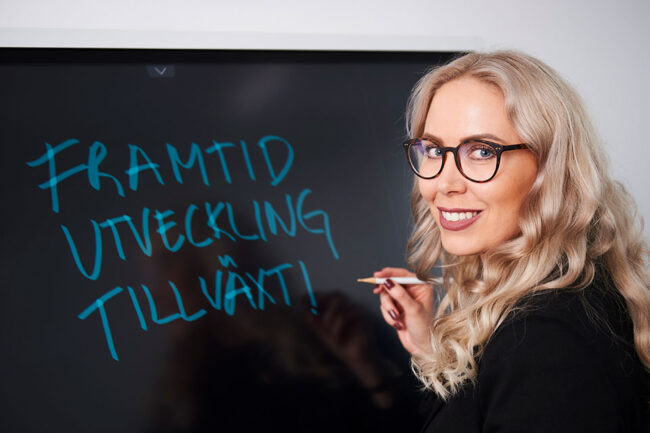
Did you notice anything in particular about the cover image for this article? Sure, we dressed the person in a pretty stylish sweater, but did you also notice that the entire image is AI-generated—or maybe you can’t tell the difference anymore?
This is where everyone involved in recruitment needs to make a choice, and no one approach is necessarily better than another. From our perspective, we believe in using smart technology to streamline processes. ByHart is at the forefront of embracing technological tools, particularly in the form of system support, and leverages a wide range of intelligent solutions (sometimes AI-based), but we have chosen not to take the final step of letting a machine handle tasks such as candidate selection and interviews. We believe there are still too many aspects to consider where human presence is crucial, not least to preserve interpersonal relationships.
But perhaps it is up to each individual to decide which method makes a recruitment process more or less biased?
AI as an ad writer?
One very popular AI trend is ChatGPT. This bot has made a huge impact; it can process vast amounts of data and provide solid answers to the challenges it’s presented with. Many people in the recruitment field were quick to jump on the bandwagon, letting ChatGPT write job postings—which, of course, saved them some time.
Develop Diverse conducted a study in which they had ChatGPT read and write new versions of job postings that people had written previously. The focus of this study was to measure inclusion and bias. The results were quite striking—ChatGPT can definitely hinder a company’s diversity efforts.
There are probably many more aspects involved.
When can AI help take some of the load off your shoulders?
While we’ve focused on some opportunities so far but also strongly emphasized the risks, here are a few ways in which you, as an HR professional, can actually use AI to become more efficient and lighten your workload.
Write and reply to emails.
Answer employee or candidate questions interactively with a virtual HR assistant.
Create and update role descriptions and profiles.
Summarize information in simple reports.
Create and update policies.
Find keywords in a resume.
Get new ideas for onboarding and offboarding.
Develop materials for internal training sessions.
Retain employees with the help of AI
There are many ways you can use AI when creating the workplace of the future. Our own product Hartic uses smart algorithms and acts as a digital HR partner, all to help you, as a leader, make the right decisions and focus on the right things in your day-to-day work. We call it AI by HR and help HR departments—which often have the primary responsibility within a company—to strengthen the employer brand in order to both attract new talent and retain key players.
In closing, it’s worth noting that things are moving at breakneck speed right now, and it’s easy to feel left behind and like a confused, less-than-successful tech whiz. If you need an assessment of your HR practices to ensure you’re using the latest technology correctly—including when you’re missing out on it and should be adopting it, as well as when you should avoid it—you should contact us and we’ll tell you more about how we can assist you.
The Confederation of Swedish Enterprise, LO, and PTK have agreed to extend support for workplace safety training. The new agreement covers the period beginning September 1, 2024
In the heart of the Norrbotten coastline, far from the hustle and bustle of the big city and where the lush green forests stretch to the horizon, we find YouCall, a company that is so
The payment service provider Klarna plans to cut 700 jobs, which is an example of the pressure that Artificial Intelligence (AI) is expected to put on the labor market. Customer service is
For several years now, the world we know has been marked by a pandemic, political tensions, war, conflict, and economic uncertainty. In such situations, it is crucial for