Our solutions are aligned with the global Sustainable Development Goals
Learn more about how partnering with us contributes to a more sustainable world, including better health, greater gender equality, decent working conditions, and economic growth.
The term “Attractive Employer” is often bandied about, but its meaning is all the more important for employers in the welfare sector to understand and embrace. It is one of three strategic areas that form the foundation for maintaining (or improving?) the welfare system over the next ten years. But what are the expectations for employers in the welfare sector, and what can private-sector actors learn from this?
The future of the welfare state rests on shaky ground. In a previous article, read How Can We Ensure Our Welfare System Has the Right Skills, we provided the background and a description of the challenges facing our welfare system. Overall, we can conclude that the solution does not lie in simply hiring more people, but rather in working strategically and with a long-term perspective in three main areas.
Retirements and demographic challenges mean that the choices we make over the next ten years will be crucial to the future of our welfare system.
The Swedish Association of Local Authorities and Regions believes that there are several solutions and categorizes them as follows: 1) Attractive Employer, 2) New Solutions, and 3) Sustainable Working Life. In this article, we will highlight the first area and explain how we need to work to ensure that we can continue to rely on a strong welfare system in the future, where healthcare, elder care, and schools, among other things, function effectively.
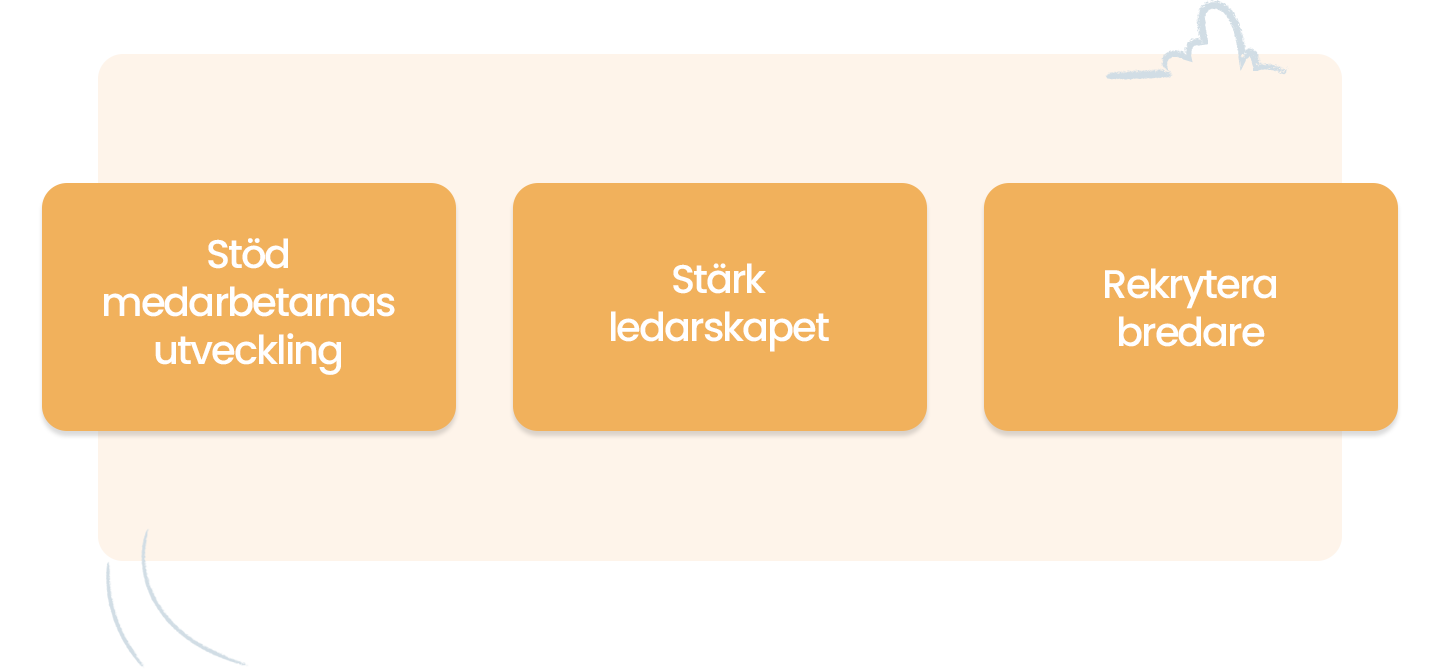
According to SKR’s definition, being an “Attractive Employer ” means supporting employee development, strengthening leadership in the workplace, and broadening the scope of recruitment.
The Importance of Supporting Employee Development
You build a strong employer brand by starting from the inside and working your way out. By that, we mean that the first step must always be to focus on the people you already have on board. Part of this involves developing employees’ skills—both to ensure the business evolves in step with societal changes and shifting public needs, and to strengthen individuals’ ability to adapt as the labor market changes. Furthermore, individuals gain opportunities for development and a chance to grow in their careers, which contributes significantly to the employer brand.
An important aspect is highlighting the opportunities available for career development. It is essential to create and clarify models for this and to incorporate professional development into the planning process. The model needs to be clear even before a new employee joins their new employer. It may even be the case that it is precisely these development opportunities that led the individual employee to sign the employment contract?
A top tip is not to skimp on onboarding or, for that matter, pre-onboarding , as it truly enhances the company’s appeal in the long run. Having a clear plan for each individual employee—covering everything from the initial preboarding to a potential final transition process—is something we work on daily with our clients through our HR partnerships.
A key factor is working systematically to develop employees who are happy in their roles and act as ambassadors for their employer—that is, who speak highly of the company and subsequently attract new employees. However, this approach must not be simplified; rather, it requires consistent and sustained effort where the employer follows a clearly defined path. In the world we live in today, it has never been easier to work smart—provided you have the right support. We always recommend that those who express a need to strengthen their employer brand use our tool Hartic, a digital HR partner that uses simple polls and surveys to help and coach leaders in building the workplaces of the future.
Strengthen leadership
Countless studies clearly show that strong leadership is a key factor when individuals are choosing their future employer; for example, see what ranks high on the list when managers themselves choose an employer. Good leadership is crucial to meeting the skills challenge, both now and in the future. It enhances the workplace’s appeal when good leaders foster engagement and harness employees’ potential.
We won’t delve too deeply into the concept of the work environment in this article, but it goes without saying that managers and their leadership play a significant role in employees’ health and the organization’s work environment efforts.
According to SKR, there are currently significant differences in the organizational conditions for managers across different government agencies, operations, and employers. These differences include, for example, the number of subordinates, access to technical and administrative support, financial resources, and access to forums where managers can meet and support one another.
Frontline managers need to be given the space to focus on their professional development and leadership skills in order to succeed in their roles. This means that organizational conditions are just as important as the right motivation and skills when recruiting managers. The opportunity to drive change should be greatest in the areas where frontline managers work.
Make sure to create opportunities for the managers closest to the operations, allowing them to focus on development and strengthen their own leadership with the employer’s support.
Technology is playing an increasingly important role in all areas. The circumstances vary for managers in the healthcare sector, and one area where we see significant potential for organizational improvement is the use of system support— Hartic being one example—to help managers become effective leaders. Take managers on the front lines—their daily lives are filled with a multitude of tasks, primarily operational, but they’re also expected to keep strategic thinking in mind, and that’s not always an easy balancing act. If, in this situation, you had a partner who helped you make the right decisions in both the short and long term, you’d save a lot of time and money. We know that this also creates engaged employees, which has a range of positive effects, such as increased productivity.
In the next article, we will explore the next strategic area: Sustainable Work Life. Here, the focus will be, among other things, on prioritizing workplace safety and health initiatives.
Fact: The Swedish Association of Local Authorities and Regions
The Confederation of Swedish Enterprise, LO, and PTK have agreed to extend support for workplace safety training. The new agreement covers the period beginning September 1, 2024
In the heart of the Norrbotten coastline, far from the hustle and bustle of the big city and where the lush green forests stretch to the horizon, we find YouCall, a company that is so
The payment service provider Klarna plans to cut 700 jobs, which is an example of the pressure that Artificial Intelligence (AI) is expected to put on the labor market. Customer service is
For several years now, the world we know has been marked by a pandemic, political tensions, war, conflict, and economic uncertainty. In such situations, it is crucial for