Our solutions are aligned with the global Sustainable Development Goals
Learn more about how partnering with us contributes to a more sustainable world, including better health, greater gender equality, decent working conditions, and economic growth.
The Swedish labor market faces a major challenge: finding the right skills for the welfare sector. Not a day goes by without most media outlets reporting on the dire need for staff across various sectors in both the private and public sectors, and the challenge is greatest in what we call the welfare sector. If we don’t address staffing needs, elder care will grind to a halt, the healthcare system will begin to collapse, and schools will see a decline in quality.
This is an introductory article in which we highlight the challenge of securing a skilled workforce in the welfare sector. We begin by providing some context on where we stand today and will focus more in the future on describing the solutions. Because they do exist.
The welfare sector is defined as municipalities and regions, including private providers. The Swedish Association of Local Authorities and Regions warns of major workforce challenges over the next ten years, with as many as 410,000 people needing to be hired in welfare professions by 2031, due to demographic changes and retirements. Things can of course change, but this is the current situation if nothing changes—and it needs to change quickly.
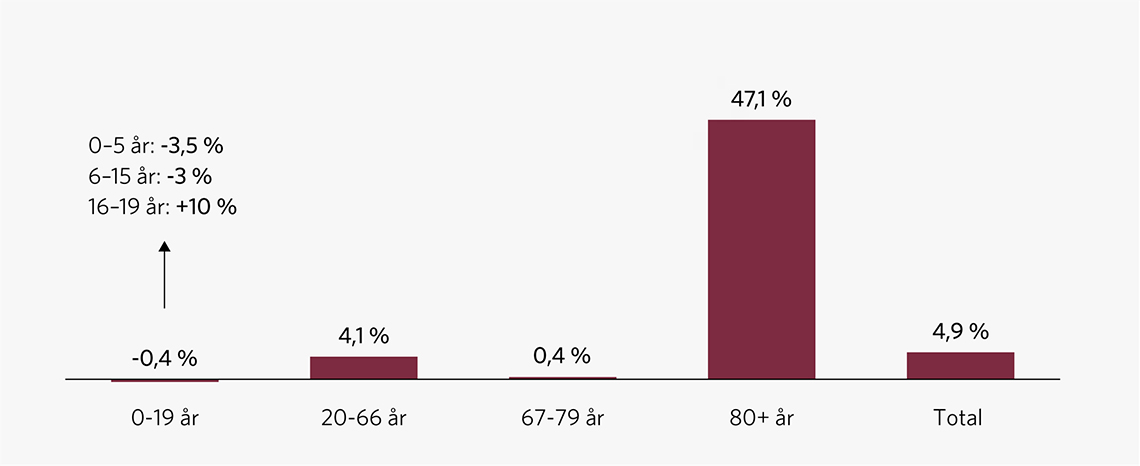
We are seeing a massive increase in the population aged 80 and older. This group is set to grow by nearly 50 percent, which alone means that elder care will need to increase its workforce by just over 30 percent—and that’s without even factoring in health care.
Our major challenge is that the working-age population will grow only modestly in the coming years. Looking at the proportion of the workforce, roughly half would need to choose careers in municipal health and social care or regional healthcare, given the demographic changes. Elderly care would require about one-third of the workforce. In addition to this, competition for the workforce outside the welfare sector is increasing. There is fierce competition for talent, and in as many as six out of ten municipalities, the working-age population is declining while welfare needs are increasing.
The chart shows population growth by age group as a percentage, 2021–2031. Source: Statistics Sweden, population as of December 31.
In a report from the Swedish Association of Local Authorities and Regions , all the results are presented in detail, along with the areas we need to prioritize to address the challenges facing the welfare system. It’s a tough job ahead, but by no means impossible.
We can summarize the demographic challenges as follows: a slowing population growth rate, a sharp increase in the number of older adults, and a declining proportion of children and young people. The working-age population, aged 20–66, currently stands at approximately 6.1 million and is projected to increase by just over 4 percent by 2031, which is a smaller increase compared to the previous ten-year period (compare 253,000 people with the previous 356,000 people, or 6.2 percent at that time). Overall, the proportion of employed people among those of working age is decreasing, due to factors ranging from unemployment to retirement, education, or sick leave, and this will not be sufficient to meet future needs.
Some facts from the report
By 2031, the number of people aged 80 or older will increase by nearly 264,000. This means that this group will grow by nearly 50 percent.
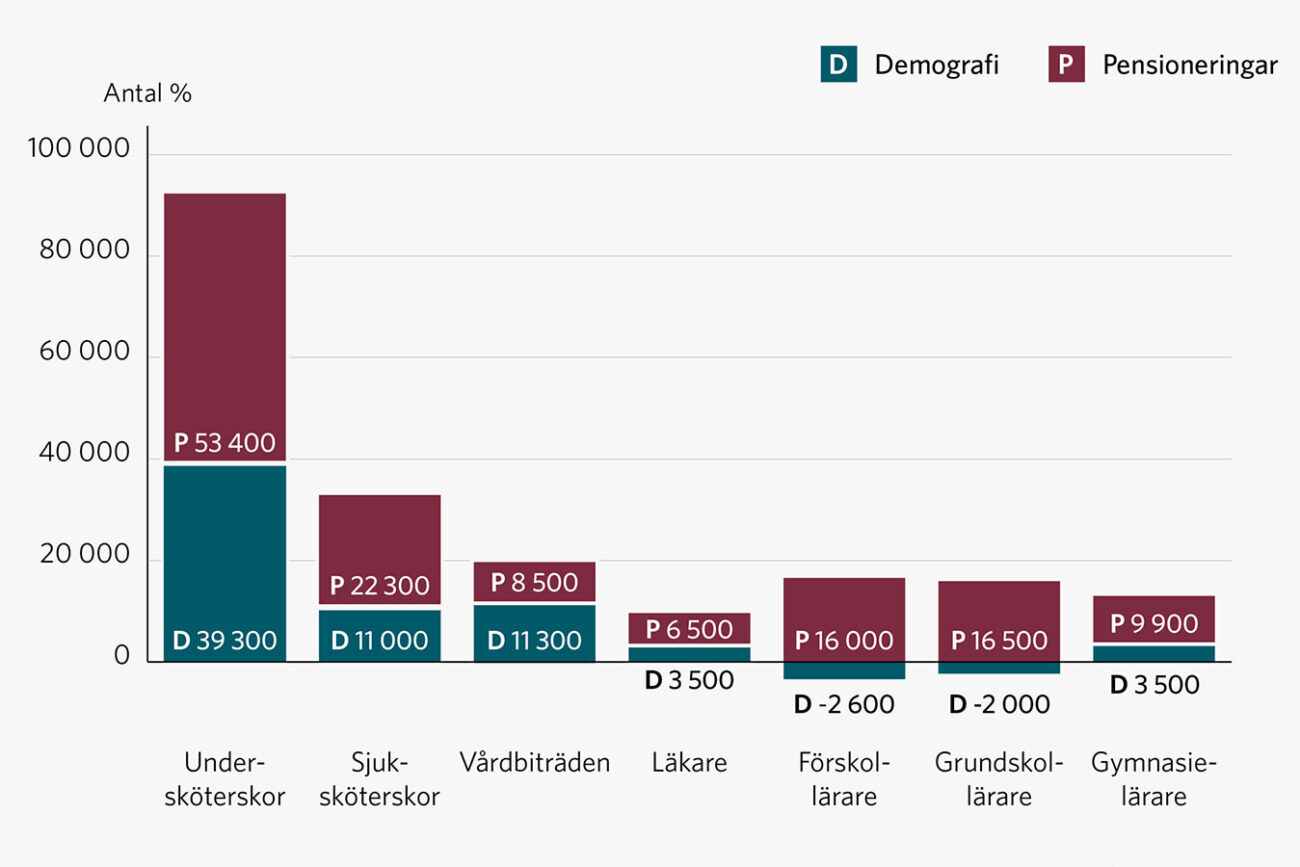
Due to demographic trends, the elderly care sector needs to increase its workforce by about 31 percent—58,500 people—by 2031. Roughly the same number of employees are expected to retire during that period. This means that, overall, the elderly care sector needs to hire 111,000 people.
Municipalities and regions (including private providers) need to hire 410,000 people by 2031.
The demand for workers in the welfare sector could decrease by a quarter if all part-time workers were to work three more hours per week and the retirement age were raised to 66 by 2031.
In the healthcare sector, the demand for workers is expected to rise by 9 percent due to demographic trends. This represents an increase of 22,500 workers. Just over 63,000 workers are expected to retire by 2031.
About half of the increase in the workforce will need to be employed in municipal health and social care or regional health care due to demographic trends.
Forecast of the need for new hires in certain occupational groups due to demographic trends and retirements between 2021 and 2031 in municipalities and regions.
How can we ensure a sufficient supply of skilled workers in the welfare sector?
It may seem bleak, but there are solutions. We can see that the slight increase in the working-age population and the number of people employed, combined with fierce competition in the labor market, cannot be resolved simply by stepping up efforts to recruit more people.
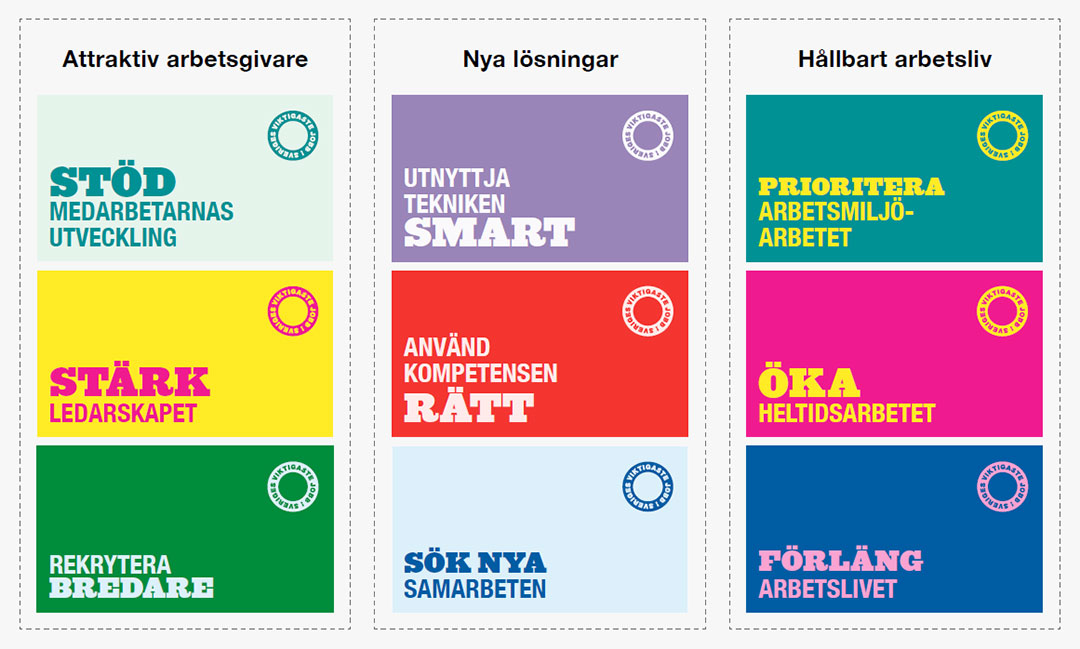
A workforce forecast prepared by the Swedish Association of Local Authorities and Regions outlines what municipalities and regions are doing and should do to address the skills challenge, based on nine strategies. It should be noted that the report assumes that employers in the welfare sector will continue to operate exactly as they do today, which is unlikely since all stakeholders, including the state, can and must take measures to maintain a high standard of welfare.
SKR summarizes the nine strategies into three areas
An attractive employer.
New solutions.
A sustainable work life.
It is clear that we need to reduce the need for additional staff by increasing full-time employment, promoting gender equality, and extending working lives, as well as retaining and developing our employees by prioritizing workplace health and safety, reducing sick leave, supporting employee development, and strengthening leadership. In addition, we need to adopt new solutions that make the right use of our expertise and leverage technology in smart ways.
The nine strategies according to the Swedish Association of Local Authorities and Regions.
We’ll be covering some of these nine strategies in upcoming articles, so be sure to follow us if you want to learn more. You can also subscribe to our newsletter where we’ll keep you updated!
Fact: The Swedish Association of Local Authorities and Regions
The Confederation of Swedish Enterprise, LO, and PTK have agreed to extend support for workplace safety training. The new agreement covers the period beginning September 1, 2024
In the heart of the Norrbotten coastline, far from the hustle and bustle of the big city and where the lush green forests stretch to the horizon, we find YouCall, a company that is so
The payment service provider Klarna plans to cut 700 jobs, which is an example of the pressure that Artificial Intelligence (AI) is expected to put on the labor market. Customer service is
For several years now, the world we know has been marked by a pandemic, political tensions, war, conflict, and economic uncertainty. In such situations, it is crucial for